
A Proud Moment for Nepal: Nepali Scientist Rojita Buddhacharya Discovers Rare ‘Island of Calm’ at the Heart of the Milky Way

Nepali astronomer Rojita Buddhacharya has made a significant contribution to the field of astrophysics with the discovery of a rare, calm pocket of gas at the center of the Milky Way, offering new insights into the earliest stages of star formation.
The discovery was presented by Buddhacharya, a PhD candidate at the Center for Astrophysics | Harvard & Smithsonian and Liverpool John Moores University, during the 248th meeting of the American Astronomical Association (AAS) in Pasadena, California.
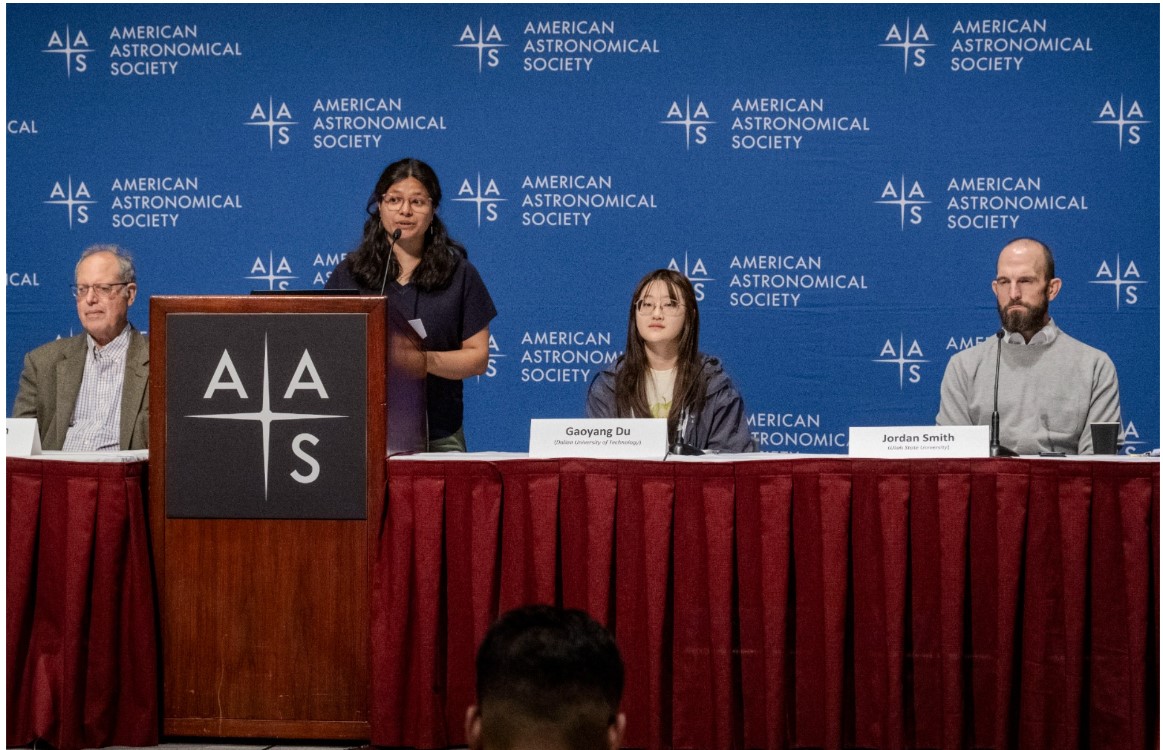
Using observations from the Atacama Large Millimeter/submillimeter Array (ALMA), Buddhacharya identified an unusually tranquil region embedded within the highly turbulent environment of the Galactic Center. The structure, described by researchers as an “island of calm,” contains dense gas moving at exceptionally low velocities, creating conditions favorable for the eventual formation of stars.
“Using ALMA, we were able to measure the motions of dense gas in the Galactic Center with very fine resolution,” Buddhacharya said while presenting the findings. “This allows us to observe, in remarkable detail, how gas transitions from a highly turbulent state to a calm one on very small scales.”
The study revealed a filament-like structure within the calm region where gas exhibits only minor random motions. In contrast, gas near the boundaries becomes increasingly turbulent and travels at much higher speeds. Researchers found that the transition from supersonic to subsonic gas occurs over a relatively short distance, providing an unprecedented view of a critical phase in the star-formation process.
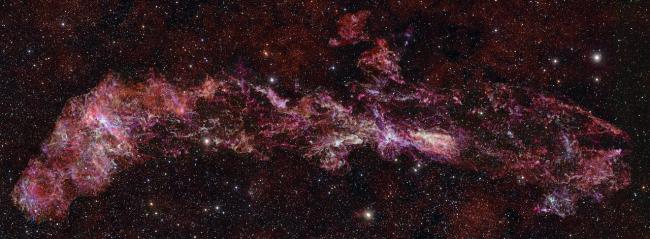
Caption: This image shows the complex distribution of molecular gas in the Central Molecular Zone (CMZ) of the Milky Way. It was obtained with the Atacama Large Millimeter/submillimeter Array (ALMA), in which ESO is a partner. This map is as long as three full moons side-by-side in the sky, and it is in fact the largest ALMA image ever obtained. This map is part of ACES — the ALMA CMZ Exploration Survey — a project designed to understand how gas condenses into stars in the extreme and chaotic environment at the heart of our galaxy.
Image Credit: ALMA(ESO/NAOJ/NRAO)/S. Longmore et al. Background: ESO/D. Minniti et al.
Further analysis showed that the gas is sufficiently dense for gravity to bind it together—one of the key conditions required for star formation. Scientists therefore consider the newly identified region a promising candidate for future stellar birth.
While previous studies of the Central Molecular Zone (CMZ) have primarily focused on already-forming stars, this research investigates an earlier and less understood stage: the calm gas structures that precede star formation.
The findings suggest that even in the Milky Way’s most extreme environments, gas can cool and settle into conditions where gravity begins to dominate. This indicates that the earliest stages of star formation may occur in a similar manner across vastly different regions of the galaxy.
The research was conducted as part of the ALMA Exploration CMZ Survey (ACES), an international collaboration involving Qizhou Zhang, Steve Longmore, Jonathan Henshaw, Daniel Walker, Rebecca Houghton, Ashley Barnes, Adam Ginsburg, and other researchers.
A Historic Achievement for Nepal
Buddhacharya’s discovery has been featured in an official press release jointly issued by the Center for Astrophysics | Harvard & Smithsonian, the National Radio Astronomy Observatory, and Liverpool John Moores University.
The achievement places a Nepali scientist at the forefront of an important international astronomical discovery and highlights Nepal’s growing presence in advanced scientific research. It also serves as an inspiration to aspiring scientists and researchers across the country.
In addition to her work in astrophysics, Buddhacharya is known as the leader of the First Women Journalist Everest Expedition 2018, reflecting a career marked by leadership, exploration, and pioneering achievements across multiple fields.